Resources

Books & Tools I Actually Recommend

These are the resources I point parents toward — not because of the commission, but because they fill the gaps my tools don’t.

Disclosure: This page contains affiliate links. If you purchase through them, I may earn a small commission at no cost to you. I only recommend what I would genuinely suggest to a parent in my office. — Caleb Adu, LCSW-C

Books That Earn a Place Here

I read these because they fill in the “why” behind the conversations BUP’s scripts help you have. Each one has a gap I’ll name honestly — because my job is to help you use it well in your household, not just hand it to you and walk away.

The Anxious Generation by Jonathan Haidt

The Anxious Generation

Jonathan Haidt

Haidt makes the strongest public case for why phones and social media are genuinely damaging this generation — and backs it with data. Read it for the research backbone. One honest note: his data is drawn mostly from Western, white middle-class samples. Come back here for how to have this conversation in your specific household, with your specific cultural context.

Read on Amazon →
Brainstorm: The Power and Purpose of the Teenage Brain by Daniel J. Siegel, MD

Brainstorm: The Power and Purpose of the Teenage Brain

Daniel J. Siegel, MD

Siegel explains the neurological reason behind your teen’s behavior in language that makes it harder to take personally. That one shift — understanding the mechanism, not just the moment — changes how you show up. Directly compatible with LSR’s Listen step.

Read on Amazon →
Hold On to Your Kids by Gordon Neufeld, Ph.D. and Gabor Maté, MD

Hold On to Your Kids

Gordon Neufeld, Ph.D. & Gabor Maté, MD

The central argument — that the relationship with you is the thing worth protecting — is the reason BUP’s connection scripts exist. If you’ve ever wondered why rebuilding closeness matters more than winning the argument, start here. One caveat: the book frames peer influence as almost entirely negative. I don’t go that far — BUP’s tools strengthen the parent relationship so the teen stays anchored, not so they stay isolated.

Read on Amazon →
Raising Good Humans by Hunter Clarke-Fields, MSAE

Raising Good Humans

Hunter Clarke-Fields, MSAE

If you picked up a BUP repair script because you’ve been in that cycle — the yelling, the guilt, the silence — this is the companion read. Clarke-Fields addresses where the reactivity comes from. The “breaking the cycle” framing lands directly with parents who were raised in households where emotional restraint was survival, not a flaw.

Read on Amazon →
The Teenage Brain by Frances E. Jensen, MD and Amy Ellis Nutt

The Teenage Brain

Frances E. Jensen, MD & Amy Ellis Nutt

Jensen wrote this after raising two sons mostly alone while running a neuroscience lab. It reads like someone who lived it, not just studied it. Good for parents who want the science behind why teens take risks and resist reason — without the clinical distance that makes most neuroscience books hard to finish.

Read on Amazon →

When You Need Something Physical

Scripts handle the conversation. These handle the moment before it — when you need something tangible in place before anyone says a word.

ySky Phone Lock Box with Timer

ySky Phone Lock Box with Timer

Amazon

A physical lock box with a timer. Useful for families where the phone agreement needs a structural backup. Works best when it’s introduced as part of a conversation — not handed down as a punishment. BUP’s screen time scripts cover the conversation that makes this land.

View on Amazon →
Mindsight Timed Lock Box

Mindsight Timed Lock Box

Amazon

A sleeker option at a lower price point. Same principle — the timer creates a structural boundary that removes the negotiation from every evening. The product works. The conversation about why it’s being introduced is the part most parents skip.

View on Amazon →
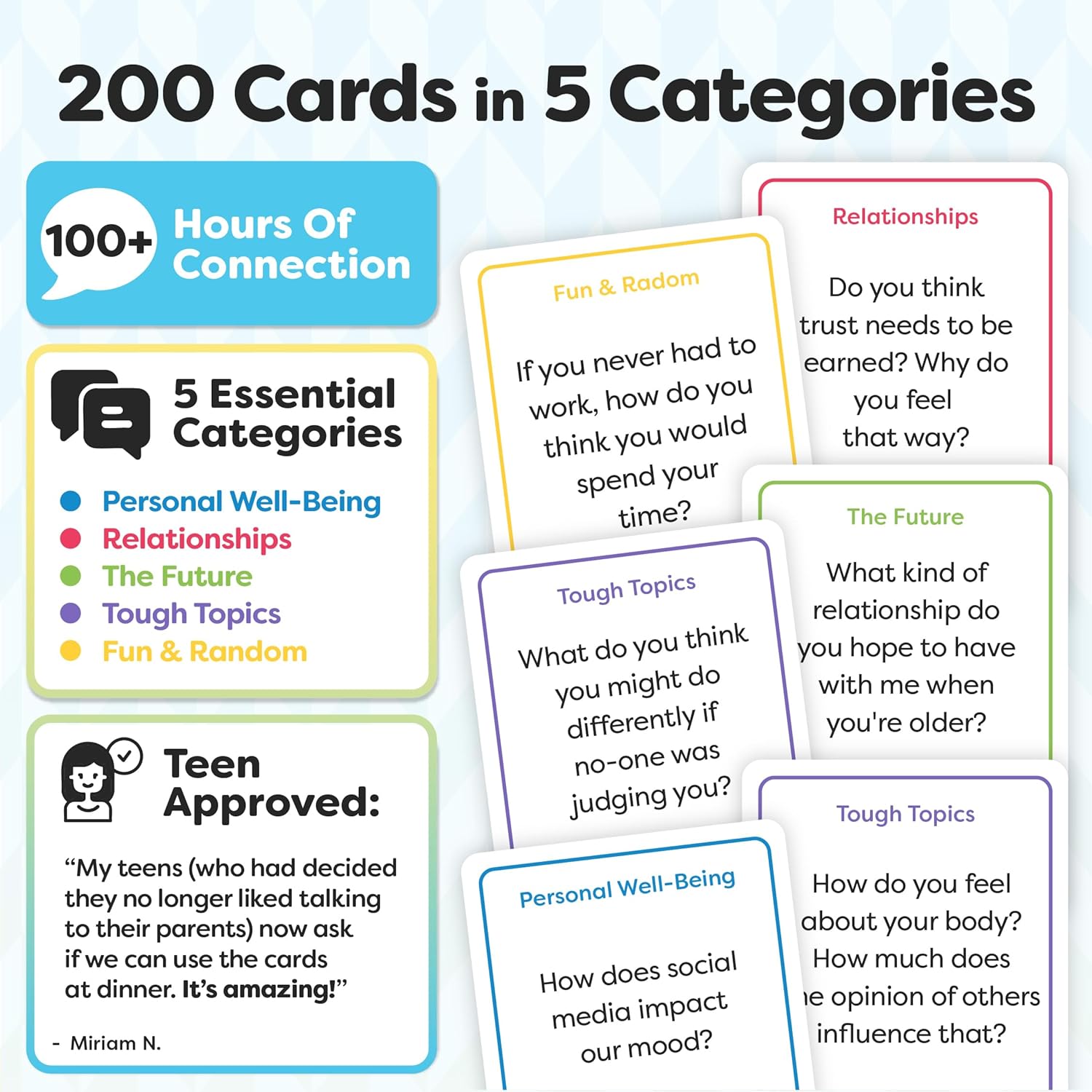
200 Conversation Cards for Teens by Talking Point Cards

200 Conversation Cards for Teens

Amazon

Conversation prompt cards for parents and teens. Lower-stakes than a sit-down conversation — the card carries the opening so neither person has to. A good entry point for families where direct conversation feels too loaded to start from scratch.

View on Amazon →

The books explain why. The scripts are for tonight.

Start with 3 free scripts — exact words for the hardest moments.

Get 3 Free Scripts →